If your alfresco sits empty nine months of the year, outdoor roller blinds in Pakenham are the fix most Melbourne homeowners overlook. Supply-and-install prices for quality outdoor roller blinds in Melbourne’s south-east typically range from $300 to $900+ per blind (mid-2026 estimate), depending on size, fabric, and system type. However, that investment transforms a wind-exposed, glare-prone pergola into a genuinely usable outdoor room. Melbourne’s south-east corridor — which includes Pakenham — experiences hot summers, gusty springs, and wet winters. Standard outdoor living areas struggle to handle all four seasons without some form of enclosure. Outdoor roller blinds are the most popular, cost-effective, and visually clean solution available to Melbourne homeowners right now.
Furthermore, alfresco usability directly affects property value in Melbourne’s competitive market. According to the Australian Government’s YourHome guide, external shading is the single most effective method for reducing summer heat gain — more effective than any internal blind or curtain. Outdoor roller blinds act as that external shading layer, protecting your home’s interior while extending your outdoor living season.
Why Pakenham Homeowners Are Investing in Outdoor Blinds Right Now
Pakenham sits in Melbourne’s outer south-east growth corridor, roughly 55 kilometres from the CBD. The area combines new estate builds with established homes, and most feature pergolas, alfresco decks, or entertaining areas. Yet many of these spaces go underused because they lack weather protection.
Summer afternoons in Pakenham regularly hit 35 degrees Celsius or above. North-westerly winds bring heat, dust, and discomfort. Then, spring arrives with its unpredictable wind gusts. Autumn brings afternoon sun that glares directly into westerly-facing pergolas. Winter is simply too exposed for comfortable outdoor sitting. Consequently, most homeowners spend significant money building an alfresco only to abandon it for indoor air-conditioning.
Verified Quick Fact Australia’s Bureau of Meteorology records show Melbourne’s south-east experiences average summer maximums above 26 degrees Celsius, with multiple days above 35 degrees each January. Source: Bureau of Meteorology Climate Averages.
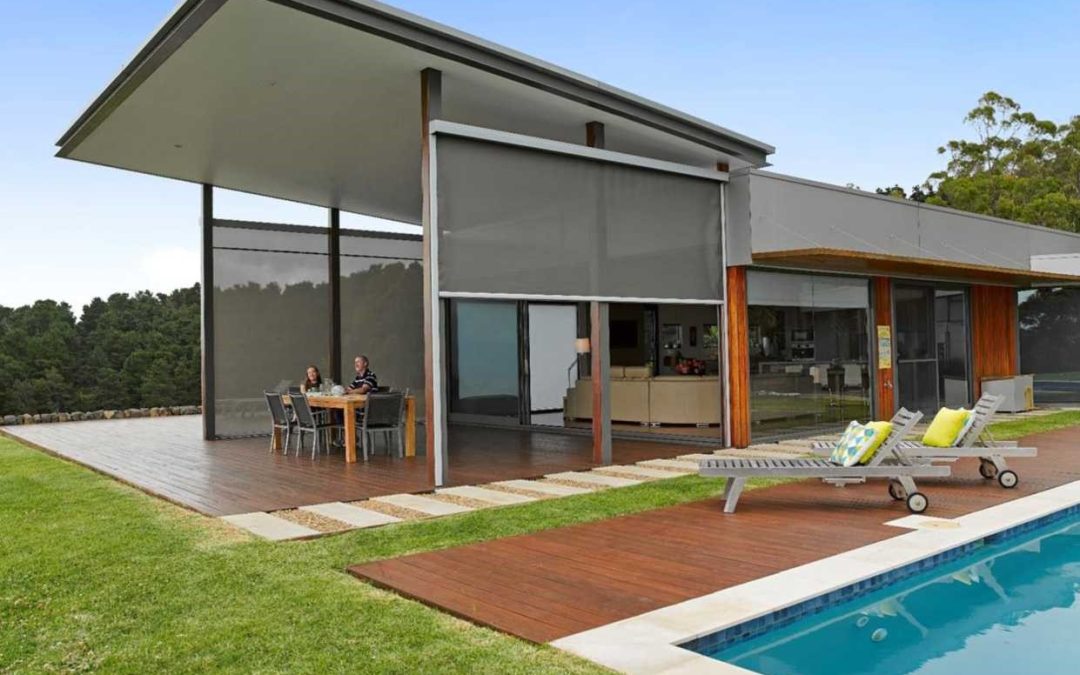
Outdoor blinds for your pergola in Pakenham solve this directly. They block afternoon sun, reduce radiant heat, provide a wind break, and create a semi-enclosed outdoor room. Many Pakenham homeowners also use them to add privacy from neighbouring properties in tighter estate layouts.
Additionally, awnings and outdoor blinds can work together as a combined system. Awnings cover the roof plane while vertical outdoor roller blinds seal the sides. Together, they create a protected entertaining space usable across all four seasons.
Types of Outdoor Roller Blinds That Suit Melbourne’s South-East Climate
Not every outdoor blind suits every application. Choosing the right material is the most critical decision you will make. Below are the main options suited to Pakenham’s outdoor conditions.
PVC Outdoor Roller Blinds
Clear or tinted PVC outdoor roller blinds are extremely popular for alfresco areas across Melbourne. They provide full weather protection, blocking rain, wind, and direct sun. Clear PVC allows you to maintain an outdoor view while staying sheltered. Tinted versions reduce glare and increase privacy. PVC is also the most common material for blockout outdoor roller blinds on alfresco walls that face east or west.
For those seeking complete privacy and full blockout performance, blockout blinds represent the residential indoor equivalent — while PVC blockout outdoor blinds deliver the same result in an exterior-grade format.
Mesh or Screen Outdoor Roller Blinds
Mesh fabric outdoor roller blinds allow airflow through the blind while filtering UV rays. They suit homeowners who want shade and UV protection without completely enclosing the space. Mesh blinds keep breezes flowing on hot Pakenham afternoons, making them ideal for summer use. They do not provide rain or wind protection to the same degree as PVC, so they work best on sheltered pergolas or roof-covered structures.
Motorised Outdoor Roller Blinds
Motorised systems add convenience. A wall switch, remote, or smart home integration controls the blind’s position. Motorised outdoor blinds suit large drops, heavy PVC spans, or multi-blind pergola walls where manual operation becomes awkward. Motorised blinds from Drowell Blinds are available for both indoor and outdoor applications across Melbourne.
Cafe Blinds vs. Outdoor Roller Blinds in Australia: What Actually Differs?
This comparison comes up constantly on Australian home improvement forums and Reddit threads. Both serve a similar purpose, but they are genuinely different products. Understanding the difference helps Pakenham homeowners make a better purchasing decision.
Cafe Blinds • Traditional PVC drop-down blind • No side channels or zipped edges • Lower cost per blind • Can move in strong wind • Good for protected patios • Less clean visual finish • Simple crank or strap operation
Outdoor Roller Blinds
• Modern roller barrel mechanism • Optional zip-guide side channels • Higher cost but cleaner finish • Greater wind stability available • Suits exposed pergolas and frames • Sleek, architectural appearance • Manual, crank, or motorised options
In short, cafe blinds are the budget-friendly traditional choice. Outdoor roller blinds represent the modern upgrade. For most Pakenham pergola installations, outdoor roller blinds deliver a superior result in terms of wind performance, finish, and longevity.
For interior applications, roller blinds from Drowell Blinds follow similar roller-barrel mechanics but use indoor-grade fabrics suited for living spaces, bedrooms, and offices.
Ziptrak Outdoor Blinds in Pakenham: The Zip-Guide System Explained
Ziptrak is a patented outdoor blind system from South Australia’s roller blind category that uses a zip-guided channel on each side of the blind. Instead of the fabric hanging freely, it locks into a track running down both sides of the opening. This prevents the blind from lifting, billowing, or distorting in wind.
For Pakenham homeowners, this is significant. Melbourne’s south-east experiences spring wind gusts that can make standard outdoor blinds frustrating. A Ziptrak or zip-guided system eliminates that problem almost entirely. The blind stays flat, sealed, and stable regardless of external wind conditions.
How the Ziptrak System Operates
The blind travels up and down inside its side guide rails. A locking bead runs along both edges of the fabric, zipping inside the channel as the blind lowers. You stop the blind at any point and release the handle — it holds that position without clips, weights, or additional fixings. Motorised Ziptrak systems connect to your smart home or wall switch for fully automated operation.
Zipscreen is a competing product offering similar zip-guided functionality. Both outperform standard cafe blinds in wind resistance. The main differences lie in brand, dealer network, pricing, and specific frame compatibility. For Pakenham homes, either system represents a significant upgrade over unguided outdoor blinds on exposed pergola sides.
UV Protection and Wind Resistance for Outdoor Blinds in Melbourne
Melbourne receives high UV radiation levels year-round. The Australian Radiation Protection and Nuclear Safety Agency (ARPANSA) classifies Australia as a high UV exposure country, with UV Index readings above 3 on most Melbourne days and extreme readings (above 11) common during summer.
Outdoor roller blinds with UV-stabilised PVC or mesh fabric block the majority of UV radiation from entering your alfresco or adjoining indoor rooms. Quality outdoor PVC blinds typically achieve UV block ratings between 80% and 99%, depending on fabric density and colour. Darker tints and denser weaves deliver higher UV blocking performance.
Wind Resistance: What Affects It?
Standard outdoor roller blinds rely on bottom weight bars and fabric tension to stay flat in wind. Moderate breezes are generally fine. However, stronger gusts cause unguided blinds to lift, flap, and potentially damage the mechanism over time.
Wind-resistant outdoor blinds in Pakenham typically use one or more of these features:
Zip-guided side channels (Ziptrak or equivalent) locking the fabric into frame-mounted rails
Heavy-gauge bottom weight bars adding tension and stability
Storm straps or locking hooks securing the blind at multiple points
Motorised override sensors that retract the blind in high-wind conditions automatically
For exposed south or west-facing pergola walls in Pakenham’s open estate layouts, a zip-guided system is the most reliable choice. Sheltered internal pergola walls benefit sufficiently from a standard outdoor roller system.
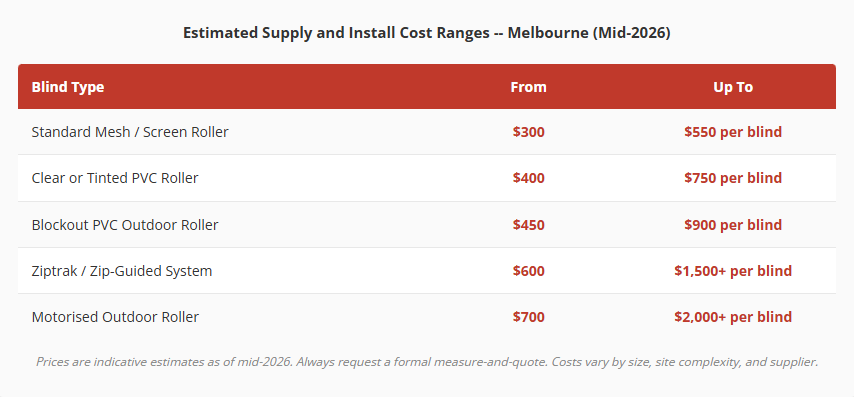
How Much Do Outdoor Roller Blinds Cost Installed in Melbourne? (Mid-2026)
Pricing transparency is one of the biggest gaps in online outdoor blind content. Most websites avoid specific figures entirely. Below is an honest breakdown of outdoor roller blinds cost for installed Melbourne projects as of mid-2026.
Important Pricing Disclaimer The following price ranges are indicative estimates based on mid-2026 Melbourne market conditions and general industry knowledge. Actual costs vary based on your specific measurements, material choices, and site conditions. Always request a formal measure-and-quote from a qualified supplier. Prices are subject to change after the date of publication.
What Affects Outdoor Blinds Price in Melbourne?
Several factors push outdoor blinds cost up or down significantly. Understanding each helps you budget accurately before requesting quotes.
Drop height and width: Larger blinds use more material and require heavier components. A 3-metre drop costs significantly more than a 2-metre drop.
Material choice: Mesh is generally cheaper than clear PVC. Blockout PVC costs more than standard tinted options.
System type: Standard roller systems cost least. Ziptrak systems add guide rail fabrication and installation labour.
Motorisation: Adding a motor, receiver, and remote control adds $300 to $600+ per blind on top of base costs.
Number of blinds: Multiple-blind projects sometimes attract better per-unit pricing from suppliers.
Access and installation complexity: High pergola frames, concrete drilling, or unusual structural situations increase labour costs.
Pricing information above is estimated as of mid-2026 and may not reflect current supplier pricing. Contact Drowell Blinds directly at 1300 883 202 for a current, obligation-free measure and quote specific to your Pakenham property.
How Outdoor Roller Blind Installation Works for Pakenham Pergolas
Professional installation starts with a thorough measure-and-quote visit. A qualified technician measures each opening, assesses the frame material (timber, steel, or aluminium), identifies anchor points, and recommends the best system for your specific pergola layout and orientation.
Step-by-Step Installation Process
Site measure: Each opening is measured precisely for width and drop, accounting for any frame overhangs or obstacles.
Product fabrication: Blinds are custom-fabricated to your measurements. No off-the-shelf sizing applies to professional outdoor roller blind installations.
Frame preparation: Mounting brackets are fixed to the top of the pergola frame. For Ziptrak systems, guide rail channels are installed on both sides of each opening.
Blind installation: The roller barrel slots into the brackets. Guide rails are aligned and fastened. The blind is tested through full operation to confirm smooth movement.
Motor wiring (if motorised): Electrical connection to a wall switch or smart system is completed. Your installer will demonstrate the system’s operation.
Final check: Every blind is tested for alignment, tension, and full range of travel before the job is signed off.
Most standard alfresco installations involve two to four blinds and complete within a half-day to full day. Larger projects or those requiring electrical work take longer. A reputable Melbourne installer will confirm the full project timeline at the quoting stage.
For commercial applications, including cafes, restaurants, offices, and retail outdoor spaces, commercial blinds by Drowell Blinds include heavy-duty outdoor roller systems sized and specified for high-traffic environments across Melbourne.
Durability, Maintenance, and How Long Outdoor Blinds Actually Last
Quality outdoor roller blinds in Melbourne typically last 10 to 15 years with routine maintenance. UV-stabilised PVC resists fading, cracking, and brittleness under Australian sun exposure. Mesh fabrics resist mildew but require regular cleaning to prevent dirt ingress into the weave.
Routine Maintenance Tasks
Monthly clean: Wipe PVC blinds with a soft cloth and mild soapy water. Avoid abrasive cleaners. Rinse thoroughly to prevent soap residue build-up.
Quarterly mechanism check: Open and close each blind fully. Listen for unusual sounds. Check that spring tension or motor operation feels smooth.
Annual lubrication: Apply a silicone-based lubricant to guide rail channels (for Ziptrak systems) and barrel end caps. This prevents wear and reduces operating noise.
Storm retraction: During forecast high-wind events, retract outdoor blinds fully. Even wind-resistant systems benefit from being stored in the barrel during extreme conditions.
Mould check: Inspect bottom hems after extended wet periods. Treat any mould spotting immediately with a diluted white vinegar solution to prevent spread.
Additionally, residential blind maintenance principles from Drowell Blinds apply similarly to outdoor products — regular care always extends product life significantly.
When to Replace Outdoor Roller Blinds
Replacement becomes worthwhile when PVC yellows or cracks visibly, when guide rail seals fail, or when the rolling mechanism develops consistent faults beyond adjustment. Most Melbourne homeowners find their first outdoor roller blind installation lasts the full 10 to 15 years with basic care.
Completing Your Pakenham Home’s Blind System Indoors and Out
Most Pakenham homeowners addressing their alfresco also review their internal window furnishings at the same time. Drowell Blinds offers a full residential range including vertical blinds, Roman blinds, double roller blinds, panel glides, and shutters for windows and doors throughout your home.
Combining external outdoor roller blinds with quality internal blockout or roller blinds creates a complete solar management system for your Melbourne home. Together, they reduce cooling loads in summer, retain warmth in winter, and give you precise light and privacy control in every room.
According to the Australian Government’s YourHome resource, combining external shading with quality internal window treatments can reduce a home’s cooling energy consumption significantly — a genuine long-term cost saving alongside the lifestyle benefits.
Frequently Asked Questions About Outdoor Roller Blinds
What are the best roller blinds for outside?
PVC and mesh roller blinds are the most popular outdoor options in Melbourne. Clear PVC provides full weather protection and maintains views. Mesh allows airflow while filtering UV rays. For maximum wind resistance, a zip-guided system like Ziptrak is the highest-performing choice for exposed Pakenham alfresco areas.
How much do outdoor roller blinds cost?
As of mid-2026, supply-and-install outdoor roller blinds in Melbourne typically range from $300 to $900+ per blind, depending on size, material, and system type. Ziptrak systems cost more due to their guide rail mechanism. Always request a formal measure-and-quote for accuracy specific to your property.
How do outdoor roller blinds work?
Outdoor roller blinds roll up and down from a barrel mounted at the top of your pergola or alfresco frame. They use a spring-tensioned mechanism, crank handle, or motorised system. When lowered, they block wind, UV rays, and rain. When raised, they retract neatly into the barrel and out of sight.
How much do outdoor blinds typically cost?
Standard outdoor blinds in Melbourne range from $250 to $800+ per drop as of mid-2026. Motorised systems, larger spans, and premium PVC materials push costs higher. Prices vary by supplier, measurement, and installation complexity. The figures above are indicative — always request a current quote.
What are the drawbacks of outdoor blinds?
Outdoor blinds require periodic cleaning to prevent mould build-up on the fabric edges. Standard systems without guide rails may flex in strong wind. Initial installation costs are higher than indoor blinds. However, long-term usability and energy saving benefits outweigh these factors for most Melbourne homeowners.
Where can I buy outdoor roll up blinds?
You can purchase outdoor roll-up blinds through specialist blind suppliers like Drowell Blinds, who offer measure, supply, and professional installation across Melbourne and the south-east. Retail hardware stores sell basic kits, but professional custom-install delivers a far better fit, finish, and warranty coverage.
Does Bunnings install outdoor blinds?
Bunnings sells basic outdoor blind kits but does not offer a professional measure-and-install service for custom outdoor roller blind systems. For pergola and alfresco installations in Pakenham, a specialist installer delivers superior results, custom sizing, and manufacturer warranty support.
What are the disadvantages of roller blinds?
Outdoor roller blinds can accumulate dust and require wiping every few weeks in dusty Melbourne conditions. Basic models without side channels may allow wind movement on exposed walls. Motorised systems add upfront cost. Despite these points, quality outdoor roller blinds remain one of Melbourne’s most cost-effective alfresco solutions.
Where is the cheapest place to buy roller blinds?
Budget roller blind kits are available at large hardware retailers. However, they lack custom sizing and professional installation. For outdoor use in Melbourne’s variable four-season climate, a specialist supplier offering custom supply and install provides better long-term value, performance, and durability.
How much do Ziptrak outdoor blinds cost?
Ziptrak outdoor blinds in Melbourne typically cost between $600 and $1,500+ per blind as of mid-2026, depending on size and motorisation. Their patented zip-guide rail system makes them more expensive than standard roller blinds. However, they offer superior wind resistance and a much cleaner architectural finish.
Are outdoor blinds worth it?
Yes. Outdoor blinds significantly extend alfresco usability across Melbourne’s four-season climate. They reduce glare, block UV radiation, lower indoor temperatures, and add privacy. Most Pakenham homeowners report year-round use of their outdoor entertaining areas after installation — a clear return on investment.
What is better, Ziptrak or Zipscreen?
Both use a zip-guided side channel system for superior wind resistance. Ziptrak is the original patented system with a broad Melbourne dealer network. Zipscreen is a competing product with similar functionality. Both significantly outperform standard roller blinds on exposed Pakenham pergola walls. Your best choice depends on frame compatibility, budget, and available local dealer support.
Can outdoor roller blinds handle Melbourne’s weather?
Yes. Quality outdoor roller blinds use UV-stabilised PVC or mesh materials engineered for Australian outdoor conditions. They handle moderate wind, rain, and high UV exposure effectively. For Pakenham’s sometimes gusty south-east weather, a zip-guided system provides added wind stability beyond standard outdoor roller blinds.
How long do outdoor roller blinds last?
Quality outdoor roller blinds typically last 10 to 15 years with routine maintenance. UV-stabilised PVC resists fading and cracking under Australian sun. Keeping the fabric clean and the mechanism lubricated annually extends their lifespan considerably beyond that range in many cases.
Do outdoor blinds reduce heat inside the house?
Yes. Outdoor blinds block solar radiation before it enters the building envelope. According to the Australian Government’s YourHome guide, external shading is the most effective method for reducing summer heat gain — outperforming internal blinds or curtains in every case.
Do outdoor roller blinds add value to a property?
Usable outdoor entertaining areas are among the top features buyers look for in Melbourne’s property market. While formal valuation data for blind-specific additions is not independently published, real estate agents consistently cite enclosed or semi-enclosed alfresco spaces as a positive selling feature in Melbourne’s south-east suburbs, including Pakenham.
Conclusion: Make Your Pakenham Alfresco Work for You
Outdoor roller blinds in Pakenham are no longer a luxury — they are the most practical upgrade available for Melbourne homeowners who want to genuinely use their alfresco year-round. Moreover, the investment returns itself through lower cooling costs, increased entertaining frequency, and improved property appeal.
Choosing the right system matters. Clear PVC suits homeowners who want full weather protection with maintained views. Mesh suits those who prioritise airflow and UV filtering. Ziptrak and zip-guided systems deliver maximum wind resistance for exposed pergola walls across Pakenham’s sometimes gusty south-east conditions. Motorised options add effortless daily operation to any of these systems.
Pricing as of mid-2026 ranges broadly from $300 to $1,500+ per blind installed, depending on your choices. However, a formal measure-and-quote from a Melbourne specialist gives you accurate numbers specific to your home and requirements.
Drowell Blinds has supplied and installed residential blinds, commercial blinds, a!nings, and outdoor solutions across Melbourne for years. Their team offers obligation-free measure-and-quote appointments, bringing experience and product knowledge directly to your Pakenham property.
Do not let another Melbourne summer pass with an unusable alfresco. Take the first step today.
If you have been researching motorised blinds in Melbourne, you already know the price range feels wide and the product options feel overwhelming. As of mid-2026, motorised blinds in Melbourne typically cost between $300 and $1,500 per blind installed – with the final figure depending on window size, motor type, fabric choice, and smart home compatibility requirements. Moreover, Melbourne’s unique mix of apartment living, heritage homes, and new builds makes this decision more nuanced than a simple cost comparison. This guide breaks down everything local homeowners genuinely need to know – from battery versus hardwired systems to Google Home compatibility, installation timelines, and which blind types pair best with automation technology.
Are Motorised Blinds Worth the Investment for Melbourne Homeowners?
The short answer is yes – but only when the system is correctly matched to your home and lifestyle. Melbourne homeowners often invest in automated window blinds for three overlapping reasons: convenience, energy savings, and aesthetics. Beyond that, motorisation genuinely solves problems that manual blinds cannot address.
Consider hard-to-reach skylights or floor-to-ceiling windows in modern Melbourne builds. Reaching those windows manually every morning is impractical. Alternatively, consider privacy on a ground-floor apartment near a busy Melbourne street – automated scheduling lets blinds close at dusk without a second thought. Furthermore, for households with elderly occupants or mobility challenges, motorisation removes a daily physical barrier.
10-15 Years average lifespan of quality motorised blinds
Up to 40% Reduction in heating and cooling energy use
$300+ Starting installed price per blind in Melbourne (mid-2026)
Pricing is indicative as of mid-2026. Costs vary by product, supplier, and installation requirements. Always request a personalised quote.
Additionally, motorised blinds add measurable value to Melbourne properties. Real estate professionals consistently cite smart home features as desirable to buyers. Consequently, the upfront investment often returns value at resale – particularly in Melbourne’s competitive inner-suburban market.
For a broader understanding of residential blind options across Melbourne, Drowell Blinds offers a comprehensive range of products suited to both new builds and renovation projects.
What Motorised Blinds Cost in Melbourne – A Realistic Breakdown
Pricing transparency matters. Therefore, rather than quoting vague ranges, here is an honest breakdown of the key cost variables Melbourne buyers should anticipate. All pricing below reflects market conditions as of mid-2026 and should be confirmed with your supplier before purchase.
Primary Cost Drivers
Window size: Wider blinds require more fabric and larger motors.
Motor type: Battery-powered motors cost less upfront. Hardwired motors offer greater reliability long-term.
Fabric selection: Blockout fabrics, sunscreen fabrics, and dual-fabric systems carry different price points.
Smart home compatibility: Wi-Fi or Zigbee-enabled motors add cost but enable Google Home and Amazon Alexa integration.
Installation complexity: Heritage Melbourne homes with cornice details or unusual window frames increase labour time.
Number of blinds: Multi-window projects often attract volume discounts.
Importantly, the cost of automated window blinds installation in Melbourne should always include professional fitting. DIY motorised blind installation carries risks – particularly with hardwired systems – and may void manufacturer warranties. Professional installation by a certified technician ensures compliance with Australian electrical standards where wiring is involved.
Battery vs Wired Motorised Blinds – Which System Suits a Melbourne Home?
This is one of the most common questions Melbourne homeowners ask before purchasing. Both systems have genuine advantages. The right choice depends on your home’s construction type, budget, and usage frequency.
Battery-Powered Motorised Blinds • No electrician required for installation • Ideal for rental properties and Melbourne apartments • Rechargeable lithium batteries last 6 to 12 months per charge depending on usage • Lower upfront installation cost • Flexible placement – no wall penetrations needed • Compatible with most smart home apps • Slightly less reliable in very high-use windows
Hardwired Motorised Blinds
• Permanent, mains-powered solution • Best for new builds and full renovations • No battery maintenance required • More consistent motor performance • Supports larger, heavier blind configurations • Requires licensed electrician for installation • Higher upfront cost but lower long-term maintenance
Notably, battery-powered motorised blinds suit Melbourne’s large apartment market particularly well. Many Melbourne apartment buildings restrict structural modifications. Battery systems bypass that issue entirely – no drilling for cable runs, no electrician coordination, no strata approval delays.
On the other hand, hardwired systems work best in Melbourne’s growing outer-suburban new-build market. When a home is under construction, integrating blind wiring during the building phase is cost-effective and seamless. Furthermore, hardwired motors handle heavier fabrics – including full blockout configurations on large picture windows – more reliably over extended periods.
Smart Home Integration – What Melbourne Homeowners Need to Know
Smart home compatible motorised blinds integrate with Google Home, Amazon Alexa, and Apple HomeKit. Image: Unsplash
Smart home adoption across Melbourne has accelerated significantly since 2023. According to the Australian Department of Industry, Science and Resources, smart home device ownership in Australia grew by over 30% between 2021 and 2024. Naturally, motorised blinds sit right at the centre of this trend.
Electric blinds compatible with smart home platforms – specifically Google Home, Amazon Alexa, and Apple HomeKit – give Melbourne residents genuine lifestyle benefits. Voice commands like “Hey Google, close the bedroom blinds” eliminate manual interaction entirely. Additionally, automated schedules can link blind position to sunrise and sunset times, dramatically improving both comfort and energy efficiency.
Key Compatibility Platforms in Australia
Google Home: Works with most Wi-Fi and Zigbee-enabled motorised blinds via Google Assistant. Supports scheduling and group automation.
Amazon Alexa: Compatible with a wide range of Australian motorised blind brands through Alexa Skills.
Apple HomeKit: Requires HomeKit-certified motors or compatible bridges. Popular among Melbourne households with existing Apple ecosystems.
Smartphone Apps: Most modern motorised blind systems include their own iOS and Android apps for remote operation anywhere in the world.
Remote Controls: Standalone radio-frequency remotes remain available for those who prefer physical operation without app dependency.
Importantly, not all motorised blind motors are equally compatible. Therefore, Melbourne buyers should always confirm smart home platform compatibility with their supplier before purchase. Drowell Blinds assists clients in matching motors to their existing smart home ecosystems during the consultation process.
Which Blind Types Work with Motorisation – A Melbourne Perspective
Almost every modern blind type supports motorisation. However, some product categories benefit more dramatically from automation than others. Here is how Melbourne’s most popular blind types perform when motorised.
Motorised Roller Blinds
Roller blinds are the most commonly motorised blind type in Melbourne. Their simple tube mechanism pairs naturally with motors. Moreover, they suit virtually every Melbourne interior – from Fitzroy terraces to Docklands apartments. Drowell’s motorised roller blinds are available in sunscreen, blockout, and dual-fabric configurations.
Motorised Blockout Blinds
Blockout blinds eliminate light completely. This makes them particularly valuable for Melbourne bedrooms and home theatres. Motorisation adds the ability to open and close them quietly and precisely without disturbing sleeping partners. See the full blockout blinds range from Drowell Blinds.
Motorised Double Roller Blinds
Double roller blinds combine a day fabric and a blockout fabric on a single headrail. Motorisation lets users switch between the two instantly – perfect for Melbourne living rooms where natural light requirements shift throughout the day. Explore Drowell’s double roller blind options to see available configurations.
Motorised Roman Blinds
Roman blinds bring a soft, fabric-forward aesthetic that suits Melbourne’s heritage and period-style interiors. Motorisation is particularly valuable here because manual Roman blind cords can be both cumbersome and a child safety hazard. Motorised Roman blinds from Drowell Blinds remove the cord risk entirely.
Motorised Vertical Blinds and Panel Glides
Large sliding door openings are common in Melbourne’s contemporary and outer-suburban homes. Both vertical blinds and panel glides benefit enormously from motorisation at these wider spans. Manual operation of a 4-metre panel glide is awkward. Motorised operation is effortless – even from the other side of the room.
Verified Fact – Source: Product Safety Australia Corded window blinds and curtains are a recognised child safety hazard in Australia. Motorised blinds eliminate accessible cords, directly addressing this safety risk. Source: Product Safety Australia – Window Covering Safety.
How Motorised Blinds Installation Works in Melbourne
Understanding the installation process removes uncertainty for Melbourne homeowners. Drowell Blinds follows a structured approach designed to minimise disruption and deliver a clean, professional finish.
Step 1 – In-Home Consultation
A Drowell Blinds consultant visits your Melbourne property. During the visit, they measure every window, assess mounting options, discuss power source preferences, and walk through fabric and colour choices. This step ensures accurate pricing and eliminates surprises at installation.
Step 2 – Custom Manufacturing
Motorised blinds are manufactured to your exact measurements. Standard lead times vary by product and volume. Your consultant will confirm the timeline during the consultation.
Step 3 – Professional Installation
A Drowell Blinds installation team fits every blind precisely. For hardwired systems, a licensed electrician coordinates the power connection in compliance with Australian wiring standards. For battery systems, installation is typically faster and causes minimal disruption.
Step 4 – Programming and Handover
Every motorised blind is programmed on-site. The installer pairs remotes, sets up app connections, configures smart home integrations, and walks you through operation. You leave the appointment confident in using your system – not uncertain.
For commercial projects across Melbourne, Drowell Blinds provides a dedicated commercial blinds installation service with project management capability for multi-window and multi-room installations.
Motorised Blinds for Melbourne Apartments – What Actually Works
Melbourne is one of Australia’s most apartment-dense cities. According to the Victorian Department of Transport and Planning, inner Melbourne’s apartment density has grown significantly over the past decade. This growth has created unique window covering challenges.
Most Melbourne apartments involve floor-to-ceiling glazing, narrow window reveals, and strata restrictions. Additionally, noise sensitivity in shared buildings makes quiet motor operation important. Modern motorised blind motors operate near-silently – a genuine advantage over the snap and rattle of manual systems on windy days.
Why Battery-Powered Systems Suit Melbourne Apartments
No strata approval required for electrical modifications
No core drilling or cable runs through concrete walls
Simple installation that tenants can potentially manage under certain circumstances
Easily removable when relocating – preserving the investment
Rechargeable via standard USB-C in most modern motor brands
Furthermore, for renters in Melbourne who cannot modify the property, some battery-powered motorised blind systems use adhesive or tension-fit mounting brackets that leave walls undamaged. This makes motorised blind access possible even without landlord approval for drilling – though renters should always confirm with their specific landlord before installation.
Energy Efficiency Gains from Motorised Blinds in Melbourne’s Climate
Melbourne’s climate is famously unpredictable. Summer heatwaves regularly exceed 38 degrees Celsius. Winter mornings consistently fall below 8 degrees. This temperature volatility makes effective window covering management genuinely important for energy bills – not just comfort.
Motorised blinds address this challenge through automation. Smart scheduling allows blinds to close automatically during Melbourne’s peak afternoon sun hours in summer – typically between 2pm and 5pm when solar gain is highest. Similarly, programmed opening in winter maximises passive solar heating during daylight hours. Consequently, households reduce reliance on both air conditioning and heating systems.
Additionally, motorised motorised awnings from Drowell Blinds extend this energy benefit to outdoor areas – blocking sun before it even reaches the glass. This pre-emptive shading is more effective than any internal blind solution during Melbourne’s extreme heat days.
For Melbourne homeowners interested in maximising both comfort and energy efficiency, combining motorised roller blinds internally with motorised awnings externally creates a layered shading strategy. This approach aligns with guidance from the Australian Government’s Your Home guide on passive solar design principles.
Motorised Blinds for Commercial Spaces Across Melbourne
Melbourne’s commercial sector presents distinct motorised blind requirements. Office buildings, hospitality venues, healthcare facilities, and educational institutions each need window covering solutions that balance privacy, light management, acoustic performance, and operational efficiency.
In commercial applications, motorised blinds deliver clear operational advantages. A single building management system can control hundreds of blinds simultaneously – adjusting the entire facade of a Melbourne CBD office building with a single command. Equally, sun sensors can trigger automatic blind deployment when solar intensity exceeds a set threshold – protecting screen visibility and reducing glare complaints from staff.
Melbourne Commercial Applications
Offices: Glare reduction for screen-based work, energy compliance, and automated building management integration.
Healthcare: Patient privacy, infection-control-friendly fabrics, and cord-free safety compliance.
Hospitality: Ambience control in restaurants and hotels, blackout capability for function rooms.
Education: Cord-free child safety compliance, light management for AV presentations, durable fabrics for high-traffic environments.
Retail: Display lighting protection and front-of-house presentation management.
Drowell Blinds provides a full commercial blinds service across Melbourne – including site consultation, project management, and post-installation support for multi-site clients.
Beyond Blinds – Motorised Shutters and Awnings for Melbourne Homes
Motorisation extends well beyond roller blinds. For Melbourne homeowners evaluating all options, motorised shutters and motorised awnings round out a comprehensive automated window treatment strategy.
Motorised shutters suit Melbourne’s period-style homes particularly well. They provide security, weather protection, and insulation in a single product. Automation allows them to close at dusk without manual effort – a genuine lifestyle benefit for busy Melbourne families.
Motorised awnings offer the most effective pre-glass solar shading available. Wind sensors can automatically retract awnings during Melbourne’s notorious gust events – protecting the fabric and motor from damage. This automation removes the most common cause of awning wear in Melbourne’s variable climate.
Frequently Asked Questions About Motorised Blinds in Melbourne
What is the average cost of motorised blinds?
In Australia, motorised blinds typically cost between $300 and $1,500+ per blind installed as of mid-2026. Price varies by window size, motor type, fabric selection, and smart home compatibility. Always request a tailored quote before committing. Pricing may change – confirm current rates with your supplier.
What are the disadvantages of motorised blinds?
The main disadvantages include a higher upfront cost compared to manual blinds, dependence on battery charge or mains power, and the occasional need for professional servicing if the motor develops a fault. However, these factors are generally outweighed by long-term convenience and energy benefits for most Melbourne homeowners.
How much do motorised blinds cost in Australia?
As of mid-2026, Australian motorised blinds are generally priced between $300 and $1,500+ per blind when professionally installed. Factors include fabric type, motor brand, window dimensions, and installation complexity. Prices fluctuate – always verify current pricing with your supplier before purchasing.
How long do motorised blinds last?
Quality motorised blinds typically last between 10 and 15 years with proper maintenance. Motor longevity depends on usage frequency, motor brand quality, and whether the system is battery-powered or hardwired. Regular servicing extends the lifespan of both the fabric and motor components.
Who has the best motorised blinds?
The best motorised blinds are those correctly matched to your specific windows, interior style, and smart home ecosystem. Drowell Blinds offers a comprehensive consultation process to match Melbourne homeowners with the right product for their specific requirements.
What is the newest trend in window coverings?
In 2026, the strongest trend in Australian window coverings is smart home-integrated motorisation – particularly systems compatible with Google Home and Apple HomeKit. Double roller blinds that combine sunscreen and blockout fabrics in a single motorised unit are also growing rapidly in popularity across Melbourne.
Do motorised blinds have to be plugged in?
No. Motorised blinds come in both hardwired (mains-powered) and battery-powered options. Battery-powered models are particularly popular in Melbourne apartments and rental properties where hardwiring is impractical or not permitted.
Do motorised shades break easily?
Quality motorised blinds from reputable Australian suppliers are engineered for daily use over many years. Cheaper imported motors can be less reliable. Choosing a trusted supplier with an Australian service warranty significantly reduces failure risk. Most modern motors handle thousands of cycles without issue.
How often do you change batteries in motorised blinds?
For rechargeable lithium battery motors, recharging is typically needed every 6 to 12 months depending on daily usage frequency. For non-rechargeable AA or D-cell battery systems, replacement intervals vary. Most modern Australian motorised blind systems use rechargeable batteries for convenience.
Are vertical blinds outdated in 2026?
No. Motorised vertical blinds remain a practical, cost-effective solution for large sliding doors and commercial spaces in Melbourne. While panel glides have overtaken them in residential popularity, motorised vertical blinds continue to suit commercial and practical-use contexts well.
Is it hard to install motorised blinds?
Battery-powered motorised blinds can be installed by competent DIYers in some circumstances. However, professional installation is strongly recommended for all systems – and legally required for hardwired models – to ensure safety, warranty validity, and correct programming of smart home features.
What are people using instead of blinds?
In 2026, motorised sheer curtains, smart glass film, and plantation shutters are the most common alternatives to traditional blinds in Melbourne. However, motorised roller blinds and double roller systems remain the dominant choice for functionality, value, and smart home compatibility.
Does Bunnings install blinds?
Bunnings sells basic blind products and offers a measure-and-install service through third-party contractors for selected products. However, Bunnings does not specialise in motorised or smart home-integrated blind systems. For motorised blind installation in Melbourne, a dedicated specialist like Drowell Blinds offers greater product range, technical expertise, and after-sales support.
Is it worth it to get motorised blinds?
For most Melbourne homeowners, yes. The convenience, energy efficiency gains, child safety benefits, smart home integration, and property value uplift typically justify the higher upfront cost over a 10 to 15 year product lifespan.
Can motorised blinds be integrated with a home security system?
Yes. Many smart motorised blind systems can be triggered by home security platforms. For example, blinds can close automatically when a security alarm is armed – enhancing privacy when the home is unoccupied. Compatibility depends on the specific security and blind motor platforms used.
Are motorised blinds safe for children?
Yes. Motorised blinds are significantly safer for children than corded manual blinds. The elimination of accessible cords directly addresses the primary child safety risk associated with window coverings. Product Safety Australia specifically identifies cordless and motorised blinds as safer alternatives. Source: Product Safety Australia.
Do motorised blinds work during a power outage?
Battery-powered motorised blinds continue to operate normally during a power outage as they run on their own battery. Hardwired systems will not operate during an outage unless a backup battery module is installed. Some premium motor brands include a manual override cord as a fail-safe for hardwired systems.
Conclusion – Making the Right Decision on Motorised Blinds in Melbourne
Motorised blinds in Melbourne have moved well beyond novelty status. In 2026, they represent a practical, energy-efficient, and genuinely lifestyle-improving investment for homeowners, apartment residents, and commercial operators across the city. The question is no longer whether motorised blinds are worthwhile – the question is which system, product type, and motor configuration best suits your specific Melbourne property and daily routine.
The right answer depends on your windows, your smart home platform, your renovation stage, and your budget. Battery-powered systems suit Melbourne apartments and rentals. Hardwired systems suit new builds and full renovations. Smart home-compatible motors suit households invested in Google Home or Apple HomeKit ecosystems. And motorised double roller blinds suit the majority of Melbourne living rooms where light requirements shift throughout the day.
Most importantly, the decision deserves a proper consultation – not a rushed online purchase. Drowell Blinds provides in-home measurement, product matching, professional installation, and ongoing support across Melbourne. Every recommendation is tailored to your specific windows, not a generic product push.
What’s the best blind for a bathroom window — roller, venetian, or something else? How do you stop mould taking hold in Melbourne’s muggy summers? And does it matter whether you’re in Kew, Dandenong, or Pakenham when it comes to choosing the right material? These are the questions we hear every week at Drowell Blinds, and this guide answers all of them — without the fluff.
Bathroom window treatments are genuinely different from every other room in your home. The combination of steam, condensation, direct water splash, cleaning chemicals, and fluctuating temperatures means the blind you choose can either last 15 years or start falling apart in 18 months. If you’re researching bathroom roller blinds in Kew, investigating blinds in Dandenong, or weighing up venetian blinds in Pakenham, this is the complete, no-nonsense resource you’ve been looking for.
We’ve been supplying and installing window furnishings across Melbourne’s south-east for over 20 years, which means we’ve seen every mistake a homeowner can make — and a few the internet hasn’t warned you about yet. Let’s start with what actually matters.
20+
Years serving Melbourne
5yr
Product warranty
100%
Australian owned & operated
Free
Measure & quote
Why Your Bathroom Demands a Specialist Blind (And What Goes Wrong When You Ignore This)
Most homeowners walk into a bathroom renovation and select blinds the same way they would for a lounge room — by looks alone. It’s an understandable mistake, but an expensive one. A standard fabric roller blind that performs beautifully in a bedroom will begin to develop mould within months in a bathroom environment, particularly in Melbourne’s humidity-prone suburbs.
Here’s what’s happening scientifically: every time someone takes a hot shower, the room fills with steam. That steam condenses onto the coolest surfaces available — including your window blind. If your blind is made from a porous material (cotton, standard polyester, real timber), it absorbs that moisture. Over time, this creates a cycle of damp and dry conditions that is the perfect breeding ground for mould and mildew. Colour fades, fabric warps, mechanisms seize up — and you’re back to square one.
The single most important rule for bathroom blinds: the material must be non-porous, or treated with a certified water-repellent coating. Everything else — style, colour, mechanism — comes second.
The specific climate in Kew and inner Melbourne’s east adds another layer of complexity. Kew experiences genuine temperature swings across the seasons: summer humidity, winter condensation on cold windows, and everything in between. Homes in Kew’s older residential streets often feature heritage-style bathroom windows — recessed into thick brick walls, non-standard in size, and sometimes angled in ways that make off-the-shelf blinds a poor fit. This is precisely why custom, made-to-measure solutions are so popular in the area.
Meanwhile, in Dandenong and Pakenham — growth corridors with a mix of established homes and new builds — the challenge is different. Newer bathrooms tend to have larger windows for natural light, which means light control becomes just as important as moisture resistance.
The Complete Material Guide: What Actually Works in a Bathroom
Not all moisture-resistant blinds are created equal. Here’s a frank breakdown of the main material categories, what they’re genuinely good for, and where they fall short.
PVC Roller Blinds
PVC is the gold standard for truly waterproof bathroom blinds. The material is non-porous all the way through — you could submerge a PVC roller blind in water and it would be completely fine when you pulled it out. There are no holes, seams, or fabric weave for mould to colonise. Cleaning is as simple as wiping it down with a damp cloth. For en-suites and main bathrooms with showers, particularly in older Kew homes where ventilation is limited, a PVC roller blind is often the most sensible long-term investment.
The trade-off is aesthetic flexibility. PVC tends to have a more utilitarian appearance than fabric options, though quality ranges vary — premium PVC can look genuinely sleek and contemporary.
Moisture-Resistant Treated Polyester
Vinyl-coated polyester and treated polyester fabrics represent the middle ground between pure PVC and standard fabric. These materials are treated with water-repellent finishes — sometimes nano-coatings — that cause water to bead and roll off rather than soak in. They offer far greater design variety than PVC: more colours, textures, and light-filtering options.
The important caveat: water-repellent is not waterproof. Over years of daily steam exposure, coatings can degrade. For powder rooms or guest bathrooms that see lighter use, treated polyester is an excellent choice. For main bathrooms and en-suites with daily showers, consider PVC or aluminium alternatives.
Aluminium Venetian Blinds
This is where bathroom roller blinds and venetian options truly diverge. Aluminium venetian blinds are moisture-resistant, rust-proof (provided the mechanism uses quality stainless or coated components), and completely mould-proof. They don’t absorb water at all. The adjustable slat design gives you precise light control — useful in bathrooms where you want natural light without sacrificing privacy. They’re particularly popular for bathrooms in Dandenong and Pakenham new builds where the contemporary aesthetic suits the interior design direction.
The maintenance note: aluminium venetian slats require individual cleaning, which takes longer than wiping down a single roller surface. Dust accumulates in the slats, and in a bathroom environment, that dust can become damp and sticky if ventilation is poor.
PVC Venetian Blinds (Faux Timber)
PVC venetians — often sold as “faux timber” or “wood look” — give you the warm aesthetic of timber Venetian blinds without any of the moisture vulnerability. Real timber warps, swells, and eventually cracks when exposed to bathroom humidity. PVC venetians look virtually identical at normal viewing distances, last significantly longer in wet environments, and are available across a wide range of colours and slat widths. For Kew homes with period-style bathrooms where the owner wants a warm, classic look, PVC venetians offer the best of both worlds.
⚡ Pro Tip from Our Installers
When fitting any venetian blind in a bathroom — aluminium or PVC — always specify stainless steel chains and brackets, not chrome-plated ones. Chrome-plated components will corrode in bathroom humidity within a few years, no matter how well-made the slats themselves are.
At a Glance: Bathroom Blind Materials Compared
Material
Waterproof Rating
Mould Resistance
Design Range
Maintenance
Best For
PVC Roller BlindBest
Fully waterproof
Excellent
Limited
Very easy — wipe clean
Main bathrooms, en-suites
Treated Polyester RollerGood
Water-resistant
Good
Extensive
Easy
Powder rooms, guest baths
Aluminium VenetianGood
Moisture-resistant
Excellent
Moderate
Moderate — slat cleaning
Contemporary new builds
PVC / Faux Timber Venetian
Moisture-resistant
Excellent
Good
Moderate — slat cleaning
Heritage & classic interiors
Real Timber Venetian
Not recommended
Poor
Excellent
Difficult
Dry areas only
Standard Fabric Roller
Not recommended
Poor
Extensive
Difficult
Dry areas only
Custom-Made vs. Ready-Made: Which Is Right for Your Bathroom in Kew, Dandenong, or Pakenham?
This debate comes up constantly, and the honest answer is that it depends almost entirely on your windows. Let’s cut through it.
When Ready-Made Works Fine
If your bathroom has standard-sized windows — the kinds you’d find in most post-2000 Melbourne builds — ready-made roller blinds from a hardware chain can be a functional, affordable option. You’ll get a decent moisture-resistant fabric, a simple chain mechanism, and a look that works for most neutral bathrooms. Installation is DIY-friendly, and you can have your bathroom covered within a day of purchase.
The limitation is precision. Ready-made blinds come in fixed size increments. In a bathroom, where an imprecise fit means light gaps at the sides and privacy issues, that gap between “close enough” and “perfect” really matters.
When Custom Is Worth Every Dollar
For Kew homeowners in particular, custom is almost always the right call. Many properties in Kew feature original Edwardian or Victorian-era windows — non-standard dimensions, often quite tall and narrow, sometimes arched at the top, and sometimes recessed deeply into masonry walls where standard brackets won’t sit flush. Off-the-shelf blinds will leave gaps, look unfinished, or simply won’t fit at all.
Custom bathroom roller blinds in Kew provide a precise fit measured to the millimetre. You also get full control over fabric choice, chain colour, cassette style, and whether you want the blind to sit inside the recess or face-mount on the architrave. For bathroom roller blinds in Dandenong‘s newer homes with larger format windows, custom sizing means you can use a single wide blind rather than joining two together — a look that’s infinitely more polished.
Our recommendation: If in doubt, measure. If your window doesn’t match a standard size precisely, invest in custom. The cost difference between ready-made and custom is often far smaller than people expect — particularly when you factor in the time and frustration of returns, workarounds, or a bad result that you’ll look at every day for years.
Light Control & Privacy: Getting the Balance Right in the Bathroom
Privacy is the non-negotiable in a bathroom. But privacy doesn’t have to mean a dark, cave-like space. Modern fabric technology has created genuinely clever solutions that most homeowners don’t know about.
Translucent vs. Blockout Roller Blinds
Translucent roller blinds allow diffused natural light to filter through while making it impossible for anyone outside to see the person inside — provided the fabric is correctly specified. Many homeowners assume translucent means visible, but the reality is that quality translucent fabrics scatter light and eliminate direct sight lines, delivering excellent privacy while keeping the bathroom bright and pleasant. For bathroom windows that face a courtyard or a neighbouring property, a quality translucent roller in a PVC or treated polyester fabric is often the ideal solution.
Blockout roller blinds, by contrast, eliminate light almost entirely when closed. These are most useful in bathrooms used at night as well as during the day, or where a window faces directly into a brightly lit outdoor area that creates a “one-way mirror” effect after dark when interior lights are on.
Venetian Blinds and Precise Light Direction
One area where venetian blinds genuinely outperform roller options is directional light control. The adjustable slats of an aluminium or PVC venetian allow you to angle incoming light upward — bouncing it off the ceiling for diffused illumination — while maintaining complete privacy from outside viewing angles. This is particularly useful for bathrooms on ground-floor level in Pakenham or Dandenong properties where the window is at eye level from the street or a neighbour’s property.
Double Roller Blinds: The Best-of-Both Solution
Melbourne’s blind market has seen a surge in double roller blind installations over the past two years, and bathrooms are increasingly part of this trend. A double roller system pairs a translucent screen fabric with a blockout panel behind it, both on separate mechanisms in a single cassette. During the day, the screen provides diffused light and privacy. At night, the blockout rolls down for complete coverage. It’s a genuinely elegant solution for bathrooms in Kew’s well-lit street-facing positions.
Venetian Blinds in Pakenham: Why This Classic Style Is Experiencing a Revival
Pakenham has undergone substantial residential development over the past decade, and with that growth has come a renewed interest in venetian blinds — not as a budget fallback, but as a deliberate design choice. Here’s why.
Contemporary Pakenham homes tend to feature large, light-filled bathrooms with generous window areas. In these spaces, the structured geometry of a venetian blind’s horizontal slats creates a clean, architectural line that complements modern cabinetry and large-format tiles beautifully. Aluminium venetians in particular — available in over 100 powder-coated colours from quality Australian suppliers — can be perfectly colour-matched to tapware, cabinetry hardware, or window frames.
The practical benefits align well with Pakenham’s climate too. The outer south-east of Melbourne experiences genuine summer heat, and venetian slats can be angled to redirect harsh afternoon sun away from the bathroom while keeping the space bright and ventilated. In winter, closing the slats creates an additional layer of insulation against cold glass — a small but meaningful contribution to energy efficiency in a room you’re heating with hot showers every day.
For venetian blinds in Pakenham, the most popular specifications we’re currently fitting include 50mm aluminium slats in matte white or warm grey tones, with stainless steel operating chains for longevity. PVC wood-look venetians in natural timber tones are the second most popular choice, particularly in bathrooms where the rest of the home features timber flooring or Hamptons-style cabinetry.
50mm aluminium slats — the most popular size for bathroom windows, fits standard recesses cleanly
25mm slimline aluminium — ideal for narrow bathroom windows or where a more minimalist look is desired
PVC wood-look in natural timber tones — pairs well with warm interior palettes
Motorised venetian options — increasingly popular for high windows or accessibility requirements
Blinds in Dandenong: Navigating a Diverse Housing Market
Dandenong is one of Melbourne’s most diverse and fast-evolving suburbs, with a housing stock that ranges from post-war brick veneers to modern apartment developments. This diversity means there’s no single “best” blind for Dandenong bathrooms — but there are clear patterns in what works well.
For the older brick-veneer properties that make up much of Dandenong’s residential housing, bathroom windows are often small and high-set — positioned for privacy and ventilation rather than light. In these bathrooms, a simple PVC roller blind in a light neutral tone (white, ivory, or soft grey) does the job efficiently and cost-effectively. The window isn’t a design feature; it’s functional. A clean, moisture-proof blind that’s easy to maintain is exactly what’s needed.
In Dandenong’s newer apartment complexes and townhouse developments — particularly those closer to the activity centres — the story is different. Larger glazed areas, floor-to-ceiling windows in combined bathroom/laundry spaces, and higher-end finishes mean that the blind is now very much part of the bathroom’s aesthetic. This is where we see the strongest demand for custom-fitted bathroom roller blinds in Dandenong with cassette finishes, coordinated chain colours, and designer fabric choices.
Commercial premises in Dandenong — offices, medical practices, retail spaces with bathroom facilities — tend to specify aluminium venetians for the combination of durability, ease of cleaning, and professional appearance. If you’re fitting out a commercial bathroom in the Dandenong area, aluminium venetians in a 50mm slat with a wand-tilt mechanism are the industry standard for good reason.
Drowell Blinds services the entire Dandenong region — from Dandenong South industrial to Dandenong North residential. Our team is based locally and carries stock of the most popular blind specifications for the area. Contact us for a free, no-obligation measure and quote.
Installation: What to Expect and How to Avoid the Most Common Mistakes
Even the best bathroom blind can underperform if it’s incorrectly installed. Here’s what a professional installation should cover — and what to watch for if you’re considering DIY.
Measuring for Bathroom Roller Blinds
The most important measurement in a bathroom is the recess depth. If you’re fitting a blind inside the window recess (which provides the cleanest look and best light control), you need at minimum 70–80mm of depth for the cassette housing. Many older Kew and Dandenong bathroom windows have deep masonry recesses that accommodate this easily. However, some aluminium-framed windows in newer builds have very shallow reveals, requiring a face-mount installation instead.
For roller blinds, measure the width at the top, middle, and bottom of the recess — in older homes, walls aren’t always perfectly square, and using the widest measurement rather than accounting for this discrepancy is a common error that results in a blind that won’t retract properly.
Bracket Placement in Wet Conditions
Standard steel screws and plugs corrode in bathroom humidity. Specify stainless steel fixings wherever possible, and ensure wall plugs are rated for the substrate (masonry, timber stud, or plasterboard — each requires a different anchor type). An improperly fixed blind in a bathroom is a safety hazard as well as an aesthetic problem.
Child Safety Compliance
All window blind installations in Australia must comply with the mandatory safety standard AS/NZS 1873, which requires corded blinds to incorporate child safety devices — either cleats at height, safety tensioners, or breakaway connectors — to prevent strangulation risk. At Drowell Blinds, every installation includes compliant child safety fittings as standard. If you’re purchasing blinds elsewhere and installing them yourself, ensure you understand and comply with these requirements. The ACCC product safety portal provides up-to-date recall information and compliance guidance.
Measure width at three points — use the narrowest measurement for inside mount
Check recess depth allows for cassette housing (min. 70–80mm)
Specify stainless steel chains and fixings in wet areas
Ensure child safety compliance per AS/NZS 1873
Confirm ventilation is adequate before closing a blind immediately after shower use
Leave a 10–15mm clearance below the sill for moisture to escape in high-steam environments
Caring for Your Bathroom Blinds: Making Them Last
With the right material and proper care, quality bathroom blinds should last 10–15 years without significant degradation. Here’s what actually makes the difference.
After Every Shower
The single most impactful habit is ventilation. Even a fully waterproof PVC roller blind benefits from the bathroom being properly ventilated after shower use — either via an exhaust fan or an open window. A blind that dries between uses will outlast one that stays damp indefinitely. If your bathroom lacks adequate ventilation, address that before investing in new blinds.
Regular Cleaning
For PVC roller blinds: a monthly wipe-down with a damp microfibre cloth and mild detergent is sufficient. Don’t use abrasive scrubbers, which can scratch the surface and degrade water resistance over time. For venetian blinds — aluminium or PVC — dust each slat with a dry microfibre cloth weekly, and do a full damp-wipe clean monthly. Pay particular attention to the tilt mechanism housing, where dust and soap residue accumulate.
When to Replace
Signs that a bathroom blind needs replacing rather than cleaning: persistent mould that returns within weeks of treatment (the material is compromised), visible warping or brittleness in PVC, slat bending in venetians that won’t straighten, or a mechanism that no longer holds position. On average, a well-chosen, properly maintained bathroom blind in the Melbourne climate should give you a decade of reliable service before replacement becomes necessary.
2026 Styling Directions: What Looks Great in Australian Bathrooms Right Now
Functionality is the foundation, but let’s talk about what’s actually looking great in Melbourne bathrooms in 2026.
Neutral tones dominate — but they’ve moved on from stark white. The current preference across Kew’s renovated heritage properties and Pakenham’s contemporary builds alike is for warm whites, soft putty tones, and greige (a grey-beige hybrid) that sits harmoniously with the terracotta and natural stone tile trends that are currently reshaping Melbourne bathroom interiors. A PVC roller blind in a warm ivory or linen tone reads as deliberately chosen rather than default.
Texture is having a moment. While smooth, matte finishes remain the go-to for most, we’re seeing strong interest in lightly textured weave effects on moisture-resistant fabrics — they give a bathroom an elevated, considered look without veering into heavy pattern territory that dates quickly.
On the venetian front, charcoal aluminium slats have emerged as a strong design choice for bathrooms with black tapware — a combination that looks genuinely sophisticated and is proving very popular in Dandenong’s newer townhouse developments. White aluminium venetians, meanwhile, remain perennially strong in heritage bathrooms where the clean line of the slat echoes heritage tile work.
Motorisation is no longer a premium novelty. Smart home integration has reached the point where motorised roller blinds controlled via a wall switch or voice assistant are a practical consideration for bathrooms — particularly for high-set windows, accessibility needs, or homeowners who simply want a seamless, cord-free finish.
Frequently Asked Questions
These are the questions our team gets asked most often by Melbourne homeowners researching bathroom blinds.
What is the best blind for a bathroom in Melbourne?
For main bathrooms and en-suites with daily shower use, a PVC roller blind is the most durable, lowest-maintenance option. It’s fully waterproof, mould-proof, and easy to clean. For powder rooms with lower moisture exposure, a moisture-treated polyester roller blind gives you more fabric and colour options while still performing well. Aluminium or PVC venetian blinds are also excellent choices if you want precise light control via adjustable slats.
Are roller blinds or venetian blinds better for bathrooms?
Both work well provided you choose the right material. Roller blinds (PVC or moisture-treated polyester) offer easier cleaning — one wipe across a flat surface versus cleaning individual slats on a venetian. Venetian blinds (aluminium or PVC) offer superior directional light control via adjustable slats and are also fully mould-resistant. The choice often comes down to aesthetic preference and your bathroom’s light control needs.
Do bathroom roller blinds get mouldy?
Standard fabric roller blinds absolutely can develop mould in bathroom environments. PVC roller blinds, however, will not develop mould — the material provides no nutrients for mould spores and doesn’t absorb moisture. Moisture-treated polyester fabrics are mould-resistant but not mould-proof; adequate ventilation and regular cleaning keep them in good condition. The key is choosing the right material from the outset, not hoping a standard blind will cope.
Can I use real timber venetian blinds in a bathroom?
We strongly advise against it. Real timber absorbs moisture, which causes swelling, warping, paint cracking, and ultimately structural failure of the slats over time. The warm aesthetic of timber venetians is understandably appealing — and the good news is that PVC “faux timber” venetians replicate the look almost indistinguishably while performing perfectly in wet environments. For bathrooms, always choose PVC over real timber venetian blinds.
How much do custom bathroom roller blinds cost in Melbourne?
Pricing varies based on size, fabric specification, mechanism type, and whether a cassette and side channels are included. As a general guide, custom-made bathroom roller blinds for a standard bathroom window start from approximately $150–$250 supply and install, with premium specifications and larger windows priced accordingly. Venetian blinds can be more affordable per window. Drowell Blinds provides free, no-obligation measure and quote appointments — contact us for a specific price for your windows.
How do I clean bathroom roller blinds?
For PVC roller blinds: fully extend the blind, wipe down with a damp microfibre cloth using a small amount of mild detergent, rinse with a clean damp cloth, and allow to fully dry before retracting. Never retract a wet PVC blind onto itself, as this can cause sticking. For treated polyester roller blinds, follow the manufacturer’s care instructions — most can be spot-cleaned or sponge-washed while still in position. Avoid high-heat drying or harsh chemical cleaners on any fabric blind.
Do Drowell Blinds supply and install in Kew, Dandenong, and Pakenham?
Yes. Drowell Blinds services Melbourne’s south-east extensively, including Kew, Dandenong, Dandenong South, Pakenham, and surrounding suburbs. We carry stock of our most popular specifications and offer a free in-home measure and quote service. Call us on 1300 883 202 or contact us online to schedule a consultation.
What’s the difference between blockout and translucent roller blinds for bathrooms?
Translucent roller blinds allow diffused natural light to filter through while preventing clear sight lines into the bathroom — you see shapes and light, not detail. They’re ideal for bathrooms that need good natural light without sacrificing privacy. Blockout roller blinds block virtually all light when fully closed, creating complete darkness and privacy. For most bathrooms, translucent is the preferred choice during the day; blockout suits bathrooms used in the evenings or those on ground floor with direct exposure to exterior lighting at night. Double roller systems combine both in one unit.
Are venetian blinds hard to maintain in a bathroom?
More effort than a roller blind, but not dramatically so. Each slat needs to be dusted individually — a venetian duster (or old sock pulled over the hand) makes quick work of it. For a thorough monthly clean, damp-wipe each slat with a mild detergent solution. The mechanism housing can accumulate soap residue in bathrooms; a periodic spray with a bathroom cleaner and wipe-down keeps things running smoothly. Aluminium and PVC slats will not rust, warp, or discolour with proper care.
About Drowell Blinds. Australian-owned and operated for over 20 years, Drowell Blinds supplies and installs custom blinds across Melbourne’s south-east — including Kew, Dandenong, and Pakenham. All products carry a 5-year warranty. We offer free in-home measure and quote appointments, with no pressure and no obligation.
Ready to Sort Your Bathroom Blinds?
Get a free measure and quote from Melbourne’s trusted local specialists. We’ll visit your home, measure every window precisely, and present you with the right options for your bathroom — no pressure, no upselling.